
Measure What Moves Revenue
More leads can look like progress, yet a growing contact list does not guarantee more customers or revenue. If new prospects are a poor fit, stall before speaking with sales, or cost too much to acquire, higher volume can hide a weak return.
A useful lead-generation funnel follows prospects from their first interaction through qualification, sales opportunity, and purchase. At each handoff, track how many move forward, how long progression takes, and what marketing and sales investment it requires. This gives you a clearer view of both conversion problems and the full cost of winning customers.
The practical standard is simple: assess marketing by lead quality, stage progression, and customer economics, not clicks or contact volume alone. For small businesses and B2B teams, that means connecting website, search, advertising, and follow-up activity to qualified opportunities and eventual sales. This revenue-focused approach applies across services such as SEO, advertising, and AI-driven lead generation, helping teams examine whether activity is producing useful prospects rather than just more names.
Treat the Funnel as a Connected System

A lead-generation funnel is marketing’s process for attracting potential customers, capturing their contact details, building interest and assessing early fit. The sales funnel picks up with qualified prospects and moves them through conversations, proposals, negotiation and a decision. Treating these as separate but connected responsibilities helps show whether marketing activity is creating opportunities sales can advance.
The journey usually moves from awareness and discovery to consideration and evaluation, then to decision and conversion. Someone researching a problem may need a useful article or guide, while a prospect comparing providers may be ready for a case study, pricing information or a sales conversation. Match each message and call to action to the buyer’s readiness instead of asking every visitor to make an immediate purchase.
This connection makes early activity meaningful. A search visit or ad response is not a business result on its own; it matters when it attracts a suitable lead who progresses toward a sales conversation and, ultimately, a customer. This buyer-focused approach applies across services such as SEO, paid advertising, content and lead nurturing. The lead funnel guidance also emphasizes tying funnel measures to revenue.
Marketing and sales should agree on what counts as a qualified lead and when a prospect is ready to move between stages. If marketing treats every webinar attendee as qualified but sales expects a senior decision-maker with clear buying intent, handoffs stall and reports give a misleading picture of performance. Write down stage definitions and qualification criteria, then use them consistently across campaigns and sales reviews.
For smaller teams, a shared spreadsheet or CRM record can make the handoff visible: capture the lead source, current stage, qualification rationale and next action. Connecting campaign activity with lead qualification and follow-up helps SMEs and B2B firms assess progress beyond the initial response.
Track Conversion at Every Handoff

A funnel-wide conversion rate can show whether you are winning customers, but it rarely explains where prospects stop moving. Measure each handoff separately: divide the number who reach the next stage by the number who entered the previous stage, then multiply by 100. Apply the calculation to visitor-to-lead, lead-to-MQL, MQL-to-SQL, SQL-to-opportunity and opportunity-to-closed-won transitions.
Define each stage before comparing results. What counts as a marketing-qualified lead or an opportunity can differ by sales model, offer and buying process. Agree on the criteria with sales, then keep them consistent over time. A high-performance lead funnel depends on connecting marketing activity to what happens after a lead is captured.
Find the handoff that needs attention
Low lead-to-MQL progression may point to broad targeting, unclear messaging or too little follow-up to educate prospects. If MQLs rarely become SQLs, review qualification rules and check whether marketing and sales share the same definition of readiness. A drop between opportunity and closed-won may call for clearer proposals, relevant case studies or more dependable follow-up. A buyer-persona-led approach can help SMEs and B2B firms align campaign messages with the prospects they want to attract.
Read conversion alongside time in stage and overall sales-cycle length. A large pipeline can look healthy while opportunities sit without a next step. Faster movement may reflect timely responses, clear ownership and useful information at each decision point. Check whether changes to follow-up or sales materials improve both progression and time to conversion, rather than judging success by pipeline size alone.
Published B2B benchmarks sometimes give ranges for individual handoffs, but these figures vary with stage definitions, industry, offer and sales motion. Treat them as directional context, not targets or proof that your funnel is underperforming. Compare each stage with your own historical results, using consistent definitions and time periods. Assess SEO, paid campaigns and lead nurturing against qualified opportunities and customer outcomes, rather than raw lead counts.
Put Lead Volume in Context
Lead count shows how many people entered your funnel, so it can help assess reach and initial interest. It does not show whether those contacts can become customers. Duplicates, invalid details, poor-fit accounts, or people who are still researching can inflate volume while consuming budget and sales time.
Cost per lead (CPL) is marketing spend divided by the number of leads generated. It offers a simple way to compare campaign efficiency, but a low CPL is not proof of quality or profit. Connecting SEO, advertising, email marketing, and lead generation with buyer-persona targeting gives businesses a basis for assessing which activity attracts relevant prospects.
Compare CPL by channel and campaign, then follow each source beyond the initial contact. Check how many leads meet qualification criteria, become opportunities, and ultimately become customers. A channel with a higher CPL may be the better investment if it consistently produces more qualified opportunities or sales.
Cost per qualified opportunity and cost per sale provide a more downstream view of performance. To calculate cost per sale, include campaign expenses and relevant follow-up costs, then divide by the number of sales generated. This captures work such as sales outreach and nurturing that a media-spend-only comparison misses.
There is no universal CPL target. The acceptable cost depends on customer value, sales-cycle length, market, and business model. Judge a lead’s cost against the likelihood and value of the customer it may produce, rather than assuming the cheapest lead is the best one.
For practical reporting, pair lead volume and CPL with qualification, opportunity, and sales outcomes. A revenue-focused approach supports that comparison: campaign performance is assessed in the context of qualified sales opportunities, not contact counts alone.
Calculate the Full Cost to Win Customers
A lead may be inexpensive to generate and still costly to turn into a customer. Customer acquisition cost (CAC) shows the full investment required to win new business: add the relevant sales and marketing costs over a defined period, then divide by the number of new customers acquired during that same period.
An advertising-only calculation can miss a large part of that investment. Include staff time and commissions, campaign and content production, software, CRM and automation tools, events, lead follow-up, promotions and onboarding when they contribute to acquiring customers. Use consistent periods and cost definitions so comparisons reflect real changes rather than accounting differences.
CAC is not the same as the cost of a specific action. A cost-per-acquisition figure might measure what a download or sign-up costs; CAC includes the broader work required to move prospects through the funnel and close a sale. Connecting services such as advertising, SEO, email marketing and appointment setting to qualified opportunities makes it possible to assess acquisition beyond the initial response.
Calculate CAC by channel, campaign, customer type or market where the data allows. Comparing these segments can reveal whether a source attracts customers efficiently or loses prospects at qualification, follow-up or closing. A connected lead funnel makes those transitions easier to assess alongside the costs behind them.
Interpret CAC with customer lifetime value (CLV or LTV), gross margin and payback time. A value-to-CAC ratio of 3:1 is often used as a guideline, but it is not a universal target; margins, retention, sales cycles and business models all affect what is sustainable. Use these measures to guide decisions, rather than treating lower CAC as success by itself.
If CAC rises, first look for ways to improve conversion before cutting budgets across the board. Tighter qualification, clearer next steps, faster follow-up and stronger marketing-to-sales handoffs can help more suitable prospects progress, improving acquisition economics without sacrificing useful demand.
Connect Campaign Spend to Revenue
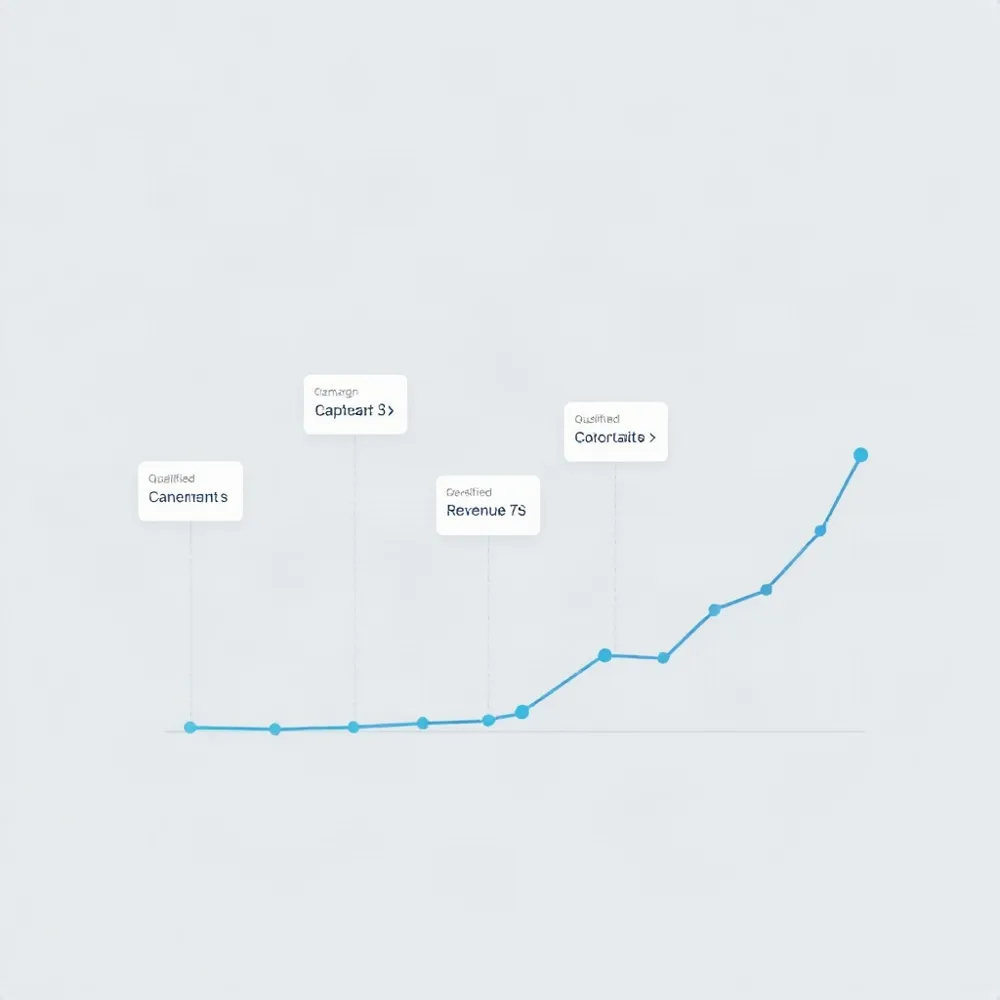
Lead-generation ROI shows whether an activity produces enough revenue to justify its cost. As a multiplier, divide revenue attributed to leads by lead-generation cost: $50,000 in revenue on $10,000 in cost equals 5× ROI. As a percentage, use (revenue minus cost) divided by cost, then multiply by 100. On $50,000 in revenue and $10,000 in cost, that calculation gives 400% ROI.
These formulas are only as useful as the records behind them. Cost per lead (CPL) is an input measure of how efficiently a campaign generates contacts; ROI is an outcome measure of the financial return. A low CPL does not establish that a campaign is profitable if its leads do not progress. An ROI-focused approach connects activity across services such as SEO, paid advertising and email marketing to qualified opportunities and customer outcomes, rather than treating contact volume as the final result.
Keep source, campaign, cost, lead status and conversion data consistent, so that revenue can be traced back to the activity that generated it. Agree on what success means before launching: an early-stage program may be judged by accepted leads or qualified opportunities, while a later-stage campaign may be expected to create pipeline or closed-won revenue. Different programs can need different evaluation periods, so a webinar and a sales-acceleration campaign should not automatically be assessed on the same timetable.
A staged review can show progress before final sales results arrive. Check acceptance, rejection reasons and response speed after roughly 7–14 days, MQL and SQL progression after 30–60 days, and opportunity or pipeline creation after 90–180 days. Closed revenue and payback may take longer. These are practical measurement windows, not universal deadlines. A short assessment can understate returns when a business has a long buying cycle.
For businesses with multi-year customer relationships, compare acquisition costs with customer lifetime value as well as first-sale revenue. This wider view can show whether a campaign brings in customers whose value develops over time. Pipeline stage probabilities can help with planning, but any illustrative stage weights should not be treated as validated conversion rates. Use observed outcomes and consistent attribution records to refine the estimate.
Account for Source and Data Quality
A campaign’s reported results are only as useful as the records connecting its first interaction to a later sales outcome. B2B buyers often encounter several messages, channels, and offers before making a decision, so crediting only the first or final touch can leave key touchpoints out.
First-touch attribution helps assess what introduced a prospect to your business. Last-touch highlights the interaction closest to conversion. Multi-touch approaches distribute credit across recorded interactions, but depend on reliable, linked data. Choose a method that fits the decision you need to make and the information you can maintain; no single model captures the whole journey.
At intake, retain the channel, campaign, offer, capture date, lead status, and a stable identifier for each record. This makes it possible to connect later outcomes to the activity that generated the lead.
Lead quality and data quality are different. Lead quality describes whether a person or account fits your target market and shows relevant intent. Data quality describes whether the record is accurate, complete, consistently formatted, and usable. A well-matched prospect with an invalid email address still cannot be routed or followed up effectively.
Duplicates can inflate lead counts, while invalid contact details, missing consent, or absent campaign information can undermine routing, conversion calculations, and ROI. A dashboard may display precise figures, but unreliable inputs can make its conclusions misleading.
Close the loop by returning accepted and rejected lead outcomes, rejection reasons, opportunity creation, and customer wins to the original source record. Compare sources by cost per qualified opportunity and downstream progression, not just lead volume or cost per lead. Use the findings to decide whether a program should be scaled, repaired, renegotiated, or stopped.
Improve Follow-Up and Funnel Progression
A lead can lose momentum when the next step is unclear or the follow-up does not match what they need. Long forms can discourage completion, while no nurture leaves interested prospects waiting. Generic messages may feel irrelevant, and a slow response can miss the moment when a high-intent enquiry is ready to talk.
Match each follow-up to the buyer’s stage. Offer useful educational content to people researching a problem, then use webinars, case studies, and email to help interested prospects assess their options. For people closer to a decision, provide a demo, clear pricing information, or a proposal that answers their questions. A buyer-persona-led approach also informs how campaigns, content, and follow-up connect through a lead funnel strategy.
Reduce friction and route leads with care
Keep initial forms short, asking only for details needed to respond. Progressive profiling lets you gather more information in later interactions. One carefully chosen question, such as company size, can help assess fit and route a prospect appropriately without making the first step burdensome.
Agree on shared marketing-qualified lead (MQL) and sales-qualified lead (SQL) criteria before routing begins. Lead scoring can help send stronger-fit, higher-intent prospects to sales, while others receive segmented nurture based on their role, industry, or interests. Buyer-persona-led marketing and AI-supported lead generation, including the DCP Lead Generator™, can support prospecting and nurturing.
Make ownership and the next action visible. A pricing-consultation request should trigger an immediate internal alert, with a named person responsible for follow-up. Track speed-to-lead and time in each funnel stage to spot delays. Email, SMS, targeted social ads, and dynamic website content can support timely, relevant contact. Behavior-based AI personalization is a developing approach, not a guaranteed result; review whether it improves progression before expanding its use.
Build a Useful Review Rhythm
A useful dashboard separates decisions about growth from decisions about daily campaign work. Business owners can review customer acquisition cost (CAC), pipeline and revenue outcomes, while marketing and sales teams inspect cost per lead (CPL) and conversion by channel, campaign and funnel stage. This keeps each view focused on the choices its users can make.
Start with a spreadsheet if your reporting is still basic. Record monthly leads, new customers and marketing spend, then calculate CPL and CAC from those figures. As campaigns and services expand, connecting SEO, advertising, email and lead-generation activity to qualified opportunities and sales outcomes helps teams assess more than lead volume.
Set the review cadence to match how quickly a measure can change. Check lead volume and CPL weekly to catch campaign shifts; review CAC and the MQL-to-SQL conversion trend monthly or quarterly, when there is more context for interpreting movement. These intervals are starting points, not fixed rules for every sales cycle.
Comparisons only work when marketing and sales use the same stage definitions, reporting periods and identifiers. If one team counts an enquiry as qualified while another does not, or campaign data and customer records update on different schedules, the dashboard may compare unlike information. Agree on definitions and check that records connect from first source through sales outcome.
Use historical conversion rates and time in stage to estimate the leads, qualified prospects and opportunities needed to support a revenue goal. Treat the result as a planning estimate, not a promise: conversion and sales timing can change with audience fit, campaign performance and sales capacity. A buyer-persona approach can make those estimates more useful by grounding targeting in the audiences a business wants to reach.
Give every metric a decision attached to it. A shift in channel conversion might prompt a targeting change; a landing-page decline could call for a page test; stalled qualified leads may point to nurture or follow-up; and rising acquisition costs may justify moving budget. If a metric cannot change a decision, reconsider whether it belongs on the dashboard.
For a practical starting framework, align the KPIs you track with the choices your team reviews each week and month.
Make Every Metric Actionable
A useful measurement plan connects stage conversion with lead quality, the full cost of acquiring customers, time to progress, and the value customers bring over time. Viewed together, these measures help explain not only where prospects stall, but whether the customers a channel attracts support sustainable growth.
Start by agreeing on funnel-stage definitions across marketing and sales. Record each lead’s source, status, and eventual outcome consistently, then review early indicators and longer-term results at intervals suited to your sales cycle. A simple, reliable tracking process is more useful than a detailed dashboard built on inconsistent data.
Use those findings to decide what to scale, fix, or stop. Connect services such as SEO, paid advertising, email marketing, and appointment setting to qualified opportunities and customer acquisition, rather than treating raw lead volume as the goal. Invest in the channels and follow-up that produce suitable customers, and reassess when the evidence changes.